
Libraries in their new role : Case Study of READ India libraries
Tough times don’t last, tough people do…
This quote is very true in the current times of COVID 19 crisis that has impacted each one of us personally, professionally, economically and socially.
The whole community is shattered. This pandemic hit the human beings, thus the humanity. People while sitting at home were able to introspect themselves, where do they stand vs a vs these pandemics or frustration, fight and tension among family members. The sufferers were busy in taking care of themselves or near and dear ones. Every individual had to take care of. Him or herself. The true meaning of family, Neighbours and extended families were realized. The GOD gave the clear message “You came alone, you have to take care of yourself alone and will go alone”. Everything else is an illusion. Children while observing the scenario understood the reality; young ones seeing the helpless situation learnt a big lesson of life, elders learnt that we should take care of mental, social and physical being of ourselves and it is never late! Libraries are human centric. Though a common man has an understanding the library has books, those who are educated can only enter this domain, rest just feel pride of having a library in their vicinity. But, no one thinks what Libraries can do to change their mindset, social life, academic career and provide direction to individual’s life. Being a common and open space for everyone, the library could be a source of information, knowledge, Center for support of any kind and human encyclopedia of a better life.
The pandemic has taught us, where to go for the basic information or a telephone number of the doctor, from where to get the medicine, who can provide the online prescription of the medicines required, hospital and ambulance contacts, oximeter, blood pressure testing machine, sugar-testing machine, oxygen cylinders and so on. No one thought that this common space in the vicinity of the village can help provide all this. What was needed was a few volunteers who could manage to strengthen these libraries.
Post COVID the priorities of the people changed from reading to skilling, higher education to livelihood, online support for banking, online food and medicine supply, thanks to technology and the mobile services. Otherwise, it would have been complete isolation.
Libraries should take this as an opportunity and train all on use of mobile technology, digital learning, online banking, online business and reaching out to masses instead of one-to-one meeting.
As heading an Organisation, Rural Education and Development (READ) India, during the first lock down in 2020, the sudden shift to technology made rural people think twice on how to use technology, but understood well that this is the only way forward.
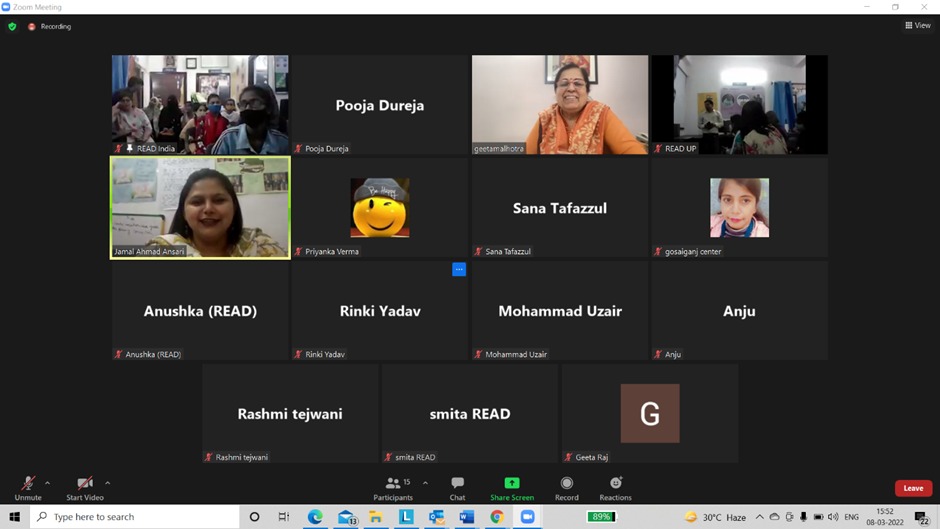
I remember, the first training was organised on zoom was to understand leadership traits and how rural women can become the leaders in their own vicinity. This training was combined with entrepreneur skills, cyber safety and security, technology empowering girls, keeping in view the interest level, basic qualifications and access to mobile. Constant handholding made them confident complemented with the workshops on mental health, life skills, confidence building etc.
I also recall that ration distribution, availability of sanitizers, soaps, masks etc. was also done by the community volunteers through libraries. Instruments like oximeters, sugar testing machine with strips, blood pressure testing digital machines were made available at the libraries for free service. The changing needs were addressed in changing time by Libraries.
During this time when the dire need of medical infrastructure and resources was tested to its limits, READ India took cognizance by contributing to prepare a ready workforce in the form of Community Health Workers in the rural communities. READ India in 2020 trained 1100 rural young women and girls by experienced doctors at multiple locations where the Centers are located. Trainees integrated under this training are now well equipped to measure Blood Pressure, Blood Glucose, Temperature, Pulse Rate, Oxygen level and measure other body parameters using different devices.

Children in all age groups suffered a lot during this period. Restricted movement outside the house led to depletion of both cognitive growth and interpersonal communication skills. Isolation and feeling of uncertainty affected the emotional state to a great degree. Educational institutions being shut and no effective learning, further deteriorated the situation. Rural communities where READ India is present, witness the dearth of amenities and resources that were available to children in urban areas. In order to bridge the gap, READ India created e-content with focussed and refined video lessons for children in the age groups of 7-11 years, 12-16 years, 16 and above. These video lessons were uploaded on a portal and each student accessing this content online was given a dedicated username and password free of any charge with no limit on content access.
Extending support to these underprivileged children in rural communities, READ India strived to fill the gulf of education and learning in the villages during the tough times when schools were completely closed.
READ India undertook short term strategic decisions to make READ Community Library and Resource Centers dynamic standpoint in the village, wherein the resources offered through could be harnessed for the best of its use.
Short term programmes were introduced through libraries:
- Sharing audio programmes made by READ India designated staff based on the certified information by the Government sources being actively shared through WhatsApp groups – Some examples are: – Sessions made on precautions to be taken during COVID 19, Hygiene practice.
- Distributed masks stitched by women, soaps and handwash kits.
- Trainings online using zoom and other tools to women, young boys and girls, parents of the differently abled children.
- Programmes on COVID– 19 and mental health are being developed with the help of an expert in the subject area and then virtual TOT sessions are being conducted.
- Reading and writing keeping age-appropriate curriculum for 2 – 6 years; 6- 10 years and 10 – 15 years. Self-evaluation forms are being added before and after each session to generate effectiveness.
Key Highlights:
- Encouraged women entrepreneur leaders to make videos on how to stitch masks, make soaps and once the lockdown is open, how to make disinfectants.
- More than 100 women have made around 1,00,000 masks for distribution.
- Module on Social Media Marketing was developed, and these women entrepreneurs were trained on using online mediums of selling their products.